PEP Knowledge Graph
Models Python's typing PEPs as an explicit knowledge graph, then reasons over it about new proposals.
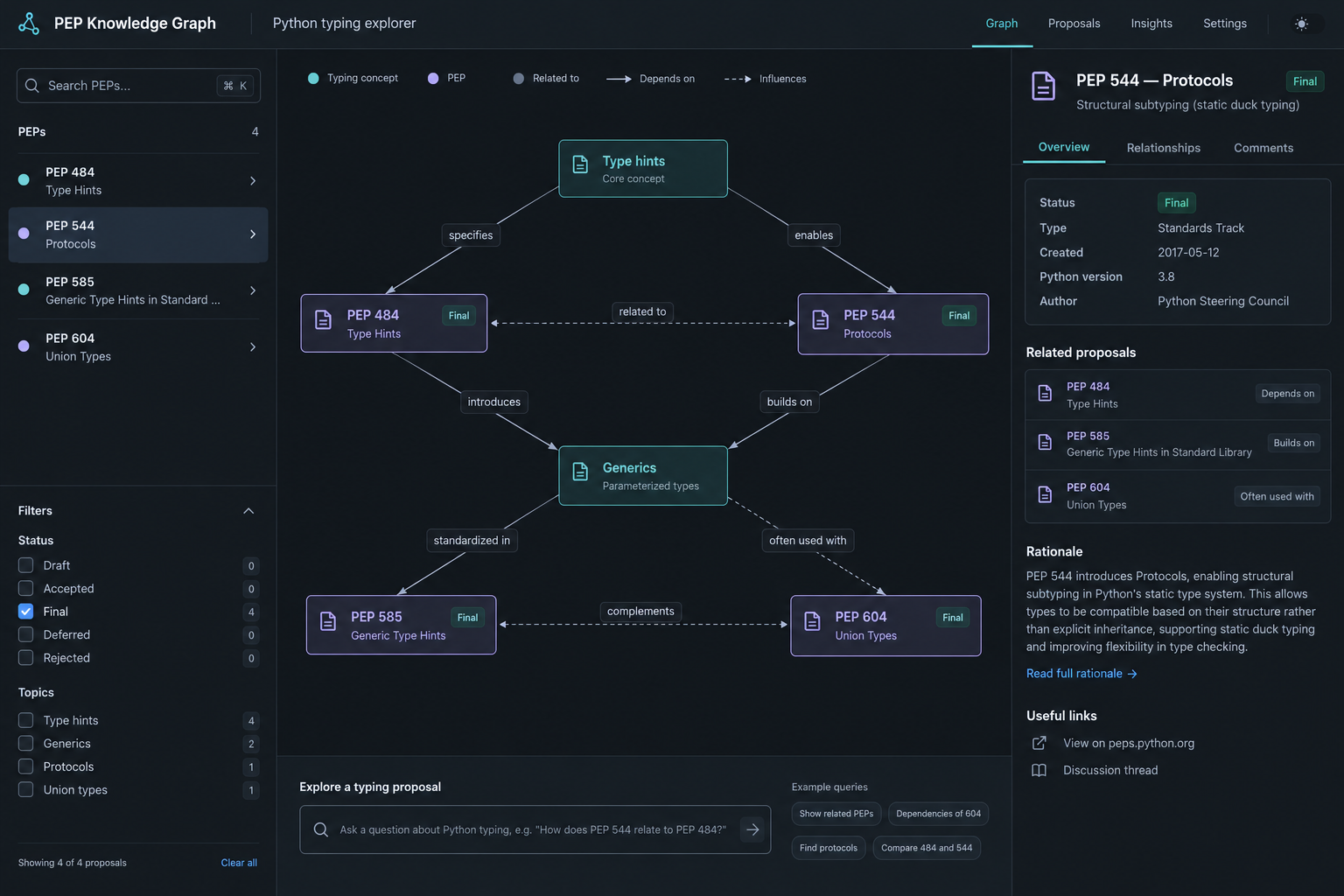
Overview
A reasoner over Python's 13 typing PEPs. Given a new feature proposal, it surfaces related prior work, current status, and likely objections — using explicit, hand-written graph logic instead of a black-box model.
Contribution Solo Project
Problem
PEP history is scattered prose. Understanding how a new typing proposal relates to prior work usually means reading a dozen documents by hand.
Approach
- 01
Model entities, relationships, and mapping logic as explicit hand-written code — fully inspectable, no embeddings or NER.
- 02
Layered extraction: header parsing → concept-vocabulary matching → RST section parsing.
- 03
LLMs (OpenAI/Gemini) used only as a fallback for structured objection extraction.
- 04
Bidirectional CLI: regenerate the knowledge state from PEPs, or query it with a new proposal.
Outcome
- Transparent, traceable reasoning across 13 typing PEPs.
- Interpretability-first design with documented tradeoffs.
- Core logic runs on the standard library alone.